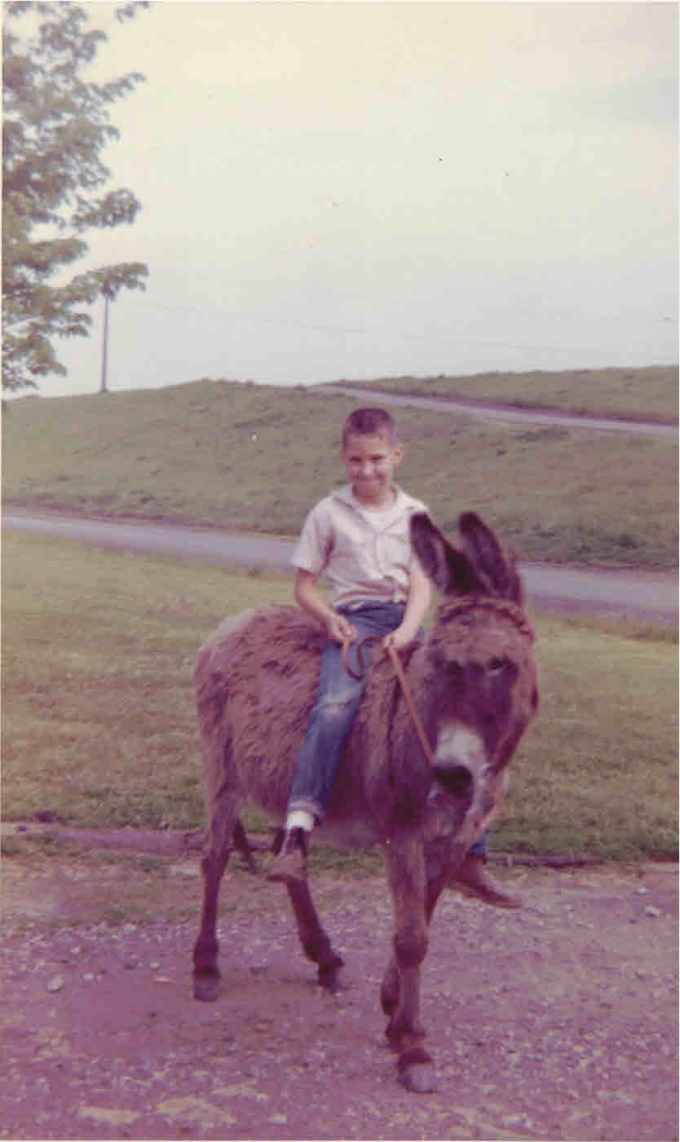
Palm Sunday

This was given on Palm Sunday of 2003 (April 13 of that year…) at the Bayliss (IL) and New Salem (IL) UMCs… A Looong drive for me from Jacksonville, IL!

The Scripture was from Mark 11: 1-11.

When people look at how I dress most assume that I must ride horses. And I do really enjoy riding when I get a chance. As I was growing up, my relatives close to Pittsfield always had at least one or two horses around whenever we would visit them. I recall one time in particular when, as a middle teenager, I was riding and went to cross a very steep ditch. The horse didn’t think much of the idea and threw me off over her head about halfway down. Everybody came running out of the house to see if I was alright, (I was) and then everybody proceeded to encourage me to get back on. You know what they say…if you don’t get back on right after a fall you never will. Apparently they didn’t know me very well! The only thing going through my head was… “Heavens YES, I’m going to get back on! No horse is going to throw ME and get away with it!”

I recall another time, some years later, when we ‘rented’ some horses down at the campgrounds where my mother and her husband were members. My son was probably around six or seven, so they gave him a very tame old mare, but I chose the big stallion that was there for myself. The guide led our little column down various trails through the Missouri woods with me bringing up the rear of our procession so that I could keep an eye on everybody and make sure they were alright. However, the stallion that I was riding was used to being up front during these treks, and fidgeted and jumped and carried on the entire trip. But I had no trouble keeping him under control, and when we were finished, the handlers commented on my ability to keep him in rein.

So if anyone ever asks me if I can ride a horse I give them a qualified YES. The qualifier is that I have never learned to gallop on a horse. That’s because I actually learned to ride on a donkey!

‘Cookie’ came with a farm that my Grandpa had bought close to Prairietown (Where ‘Holiday Shores’ is today…). We were told that she was actually a genuine Mexican burro, but most people called her a donkey. She was very old and arthritic when we got her, and that only got worse as the years went by. But at that, she could still move pretty good when she wanted to. When the Prairietown farm was sold to developers, Cookie was moved to the ‘home’ farm south of Hartford. It was there that I learned how to put a bridle on (when I could catch her!) and how to use your knee to knock the wind out of them as you cinch up the saddle. (For those who don’t know, horses, mules, and donkeys are prone to holding their breath as you draw up a saddle so that it won’t be so tight afterwards.) However, I just wasn’t big enough to make much of an impression on her with my knee, and I would sometimes be riding along when the saddle would start slipping sideways…with me still on it! I remember one time that after I was dismounted she took off running for her pasture. By the time she got there, the saddle was completely upside down under her stomach. That had to hurt! As I got older, I got to the point where I just wouldn’t mess with the saddle and rode bareback, even though she had a very sharp backbone ridge.

While at the Hartford farm, my aunt had told us how Cookie would greet each morning with a good roll in the dust, then usually get off a really good bray at the rising sun, but none of us had ever seen or heard it. As grandpa began scaling back the farm at Hartford we bought our twenty-three acres close to Edwardsville, and Cookie was brought out to spend the rest of her days there. We turned her loose in with the cows, and the first thing that she did was stampede them all through the fence at the rear of our property. After rounding them back up and mending the fence, Cookie was put into the pasture next to the house…by her self! That next morning, sometime before 6:00 AM, we were all awakened by the most horrendous noise that you could ever imagine! Slowly, I realized what it had to be! Rushing to the back door to look out at the pasture, we all saw…Cookie…braying!! Have you ever heard a donkey bray? They don’t go ‘hee-haw’. They go ‘haw-hee’. Actually they go…(YES, I BRAYED!) Believe it or not, after a while we all got used to her antics and would usually sleep right through them.

Along with taking care of her daily needs, every once in a while I would get out the bridle and ‘try’ to go for a ride. The key word here, usually, was ‘try’! People always talk about mules being stubborn. Well, I’m here to tell you that they get it from the donkey side of their parentage! We might get a mile down the road or so and she would decide that that was enough. She would just up and stop, and nothing that I could do would get her to move…period. I would finally end up walking back to the farm and get a tractor. When I returned, she would still be standing in the same exact spot, and I would tie the reins to the drawbar and pull her back home…slowly of course. So, you see, I never learned to gallop. Indeed, with Cookie, I sometimes did more walking than riding…but I did learn to ride!

Now, I’m sorry to say that I haven’t had an opportunity to ride a horse for some years now. And if the truth be known, most of my interest in horsepower has been HORSEPOWER! Even as a teenager I always claimed that given an opportunity to run a ‘Cat’ or go on a date, the choice would be a very difficult one. (It would probably depend on the girl.) But there is no denying that sitting up on a good horse gives one a feeling unlike anything else. A horse is a magnificent creature, and anyone lucky enough to be seen on one usually has some of that magnificence rub off on them as well.

Throughout the years, horses have been seen as noble creatures and symbols of power. So why, exactly, didn’t Jesus want a horse to ride into Jerusalem? Why, instead, did He choose a donkey? To understand that, we need to understand a little bit about the society and customs of the day…as well as a bit of Bible history.

The Wycliffe Bible Commentary tells that…the ass was a lowly beast, and no Jewish king since Solomon had ridden upon one officially. But meekness and lowliness were earmarks of (the) Messiah predicted by Zechariah, and now fulfilled.

And I’m sure that many people have always felt that that was the main reason…that Jesus wanted to emphasize His humbleness.

However, Barnes’ Notes points out that… In Judea there were few horses, and those were chiefly used in war. To ride on a horse was sometimes an emblem of war… on a mule (or a donkey), an emblem of peace. Kings and princes commonly rode on them in times of peace, and it is mentioned as a mark of rank and dignity to ride in that manner. So Solomon, when he was inaugurated as king, rode on a “mule”. Riding in this manner, then, was not a sign of poverty or degradation, but was an appropriate way for a king to ride… and therefore, an appropriate way for the King of Zion to enter into his capital, the city of Jerusalem!


So here we find a picture of Jesus triumphantly riding into Jerusalem, not on a warhorse as many had hoped for…but on a donkey…a symbol of peace! And furthermore, it was a colt! This was to fulfill the prophecy of Zechariah 9:9

See, your king comes to you,

righteous and having salvation,

gentle and riding on a donkey,

on a colt, the foal of a donkey.

Mark and Luke only talk about the colt, because it was this on which Jesus rode. However, Matthew tells us that both mother and colt were brought. One of my sources points out that this may have been to keep the young colt calm, which would certainly make sense to me. Since the unbroken colt would not have had any kind of saddle, the disciples threw their cloaks over it for Jesus to sit on. Then, it was on to Jerusalem!

Let me read this from the ‘Life Application Commentary’.

Crowds of people had already gathered on this stretch of road a mile outside of Jerusalem, going to the city for the Feast of Unleavened Bread and Passover.

This was not a little group of people along the wayside; this crowd was characterized as “multitudes.” The people lined the road, praising God, waving branches, and throwing their cloaks in front of the colt as it passed before them. (Many) knew that Jesus was intentionally fulfilling prophecy. This verse is one of the few places where the Gospels record that Jesus’ glory was recognized on earth.


This was the crowd’s acclamation… that he was indeed the long-awaited Messiah. The people were sure their liberation from Rome was at hand. When it became apparent that Jesus was not going to fulfill those hopes, many people would turn against him. A similar crowd would cry out, “Crucify him!” when Jesus stood on trial only a few days later.

How fickle is man? From the beginning of time mankind has chosen to accept or reject God according to whether or not it seemed convenient at the time. And here is the ultimate example…the cheering of Jesus as the Messiah into the Holy city…only to be replaced with the jeers as He went to the cross soon afterward. And you know what? Two thousand years have not changed a thing! With the attacks on this country in September of 2001 and all that has occurred since, many people have been trying to find their way back to God. And that’s great! But you and I both know that, unless someone is really able to reach out to them and help them build a real understanding and acceptance of God, as soon as things begin to settle back into a routine most of these people will drift away again.

And what about us? Here we are on Palm Sunday, celebrating the triumphal entry of Jesus into Jerusalem two thousand-odd years ago. But what will we be celebrating tomorrow? Or Tuesday? Or next week? Will we hold firm to our belief and our joy in the Son of God? Or will WE begin backsliding into the everyday world around us?

Maybe I’m a little luckier than some people…my experience with riding a donkey as a child gives me some connection that I can relate to in the Gospel story, albeit a very minute one. But the truth is everyone of you, every member of your family, every one of your friends and coworkers, indeed every person on this earth has a direct connection if they would just open up to it!

Let me read this ‘bit’ I got in my e-mail some time ago…

The man whispered, “God, speak to me”…and a meadowlark sang.

But the man did not hear.

So the man yelled, “GOD, SPEAK TO ME!”…and thunder rolled across the sky.

But the man did not listen.

The man looked around and said, “God, let me see you”…and a star shone brightly.

But the man did not see.

And the man shouted, “GOD, SHOW ME A MIRICLE!”…and a life was born.

But the man did not notice.

So the man cried out in despair, “Touch me God, and let me know you are here”…whereupon God reached down and touched the man.

But the man brushed the butterfly away and walked on.

God is in our lives everyday. He reaches out to us everyday. He’s with us as we sleep, when we wake, as we work and play, and as we prepare for sleep yet again. Is it really so much to ask to let Him be a part of lives on a Monday or Tuesday as well as a Sunday? After all, remember what He did for us…He sent His Son to die on the cross of Calvary in our place. Then raised Him from the tomb to show the world that we can all conquer death and live in eternal Paradise with Him in the place prepared. I don’t know about you, but I feel like shouting Hosanna!

Baby Huey

THIS was the ‘sermon’ that I put together for my Very First ‘Lay-Speaking’ class back in March of 2001!!

The Scripture was from Luke 8: 26-39…

I think that it was 1965 when my grandpa on dad’s side decided to retire and sell off most of the farm ground and equipment. We had been looking for a small farm of our own and wound up buying one near Edwardsville at about the same time, so some of the equipment and animals made it to our place. I was 12 and my brother 9 when we moved there over the Christmas holiday that year.

Growing up in a small town was neat, but being on the farm was fabulous! Our old farmhouse was on the side of a hill, and when the snows came you could really get a sled moving down into the field. In fact, I got the notion to take buckets of water and dump them down the path that I had made so that it would freeze over. It worked pretty well. I could almost make it to the road. Well, at least I made it over halfway there.

It was also great, for me, to be around so many animals. We had brought our cat with us from town, and had gotten a young collie to take with us. That winter we hauled several of our Hereford cows from the the farm near Prairietown to our pasture… after we fixed all of the fences… along with one ‘prize’. Grandpa had gotten a genuine Mexican burro included with the purchase of that farm, and Cookie became a member of our family. She was old and arthritic and stubborn as a…. well, stubborn as a donkey! But, she was what I learned to ride on. That’s why, to this day, I don’t really know how to gallop!

Over the years, dad had been putting some money into my brothers’ and my savings account, so when he wanted to buy four bred sows that summer, he asked us if we would each like to go halves together on one. We said YES. After we hauled them and unloaded them into their pasture, my brother and I got to pick out which one was ‘ours’. One sow was far-and-away bigger than the other three, and we enthusiastically chose her.

“Now,” dad said, “just because she’s the biggest doesn’t mean that she’ll have the most pigs!” We didn’t care. That was our choice, and we were sticking with it! And you know what? She DID have the most pigs! If I remember right, she had thirteen and managed to keep 12! We were happy.

Sometime after that, one of our sows had a litter with a little runt in it. Dad brought it into the house to hand raise. The poodle that we had by then adopted it and stayed by its box. Pierre would bark to let us know when it was awake so that we could feed it, first with an eyedropper, and eventually with a baby bottle. Baby Huey survived and became another family pet. She was housebroken, just like the dog. First to a newspaper, and then to oink when she needed outside. When she got big enough to start rearranging the furniture, she became an outside pet. I vividly remember friends from church coming to visit and start to come up the walk only to turn around and run back to their car screaming “PIG” when they saw ‘Huey’ running towards them.

Now, I told you all of this to make a point. I appreciate the many values of a pig. Pigs are intelligent. Pigs can be loyal. And, normally, pigs are valuable. I said normally.

So when I read how Jesus sent these spirits into a herd of pigs, my first reaction is…WHY mess with the pigs?! These pigs were valuable! Mark 4:13 tells us that there were ‘about two thousand’ of them! That’s a lot of pigs! WHY mess with the pigs?

Because, to Jesus, this one man was worth more than any number of pigs!

What price do you put on a mans’ soul? Can you value it in dollars and cents? What kind of price tag would you put on your own soul? There have been times when I thought mine wouldn’t have been worth very much.

But God’s values are different from our own. Each and every one of us is invaluable to Him.

Now, we’re told that when the people who saw all of this happen reported it, everyone had to come out and see for themselves. And, instead of rejoicing for the mans’ recovery, they were ‘overcome with fear’, and asked Jesus to leave.

Are you afraid of Jesus? Afraid of what He might see in your life? There’s no need to be. Because He values each one of us just as much as He did this man. In fact, helping that man only cost a herd of pigs. To save you and me, He gave His life. And how much is that worth?

nostory

This continues my ‘series’ of sermons given through the Lenten season at the Lynnville (IL) UMC during 2005. THIS was for the 5th Sunday of Lent that year [March 13], and the Scripture was from John 11: 1-45.

As I say in it, I could not come-up with Any ‘personal-story’ that might relate to the theme, and so my ‘notes’ identify it as simple ‘nostory’ (No Story) …


The Life Application Commentary notes that, “Up to this point in John’s Gospel, Jesus has presented himself as the giver of life to various people:

  • to Nicodemus, he offered eternal life
  • to the Samaritan woman, the water of life
  • to the official’s son and the lame man, the restoring of life
  • to the hungry multitude, the bread of life
  • to the blind man, the light of life
  • to the sheep who followed him, the abundant life

In chapter 11, Jesus is “life” in its ultimate expression — he is “the resurrection and the life” — life after death. To the dead man, Lazarus, he offered resurrection life.”

Now, Time Magazine has always had a reputation for printing striking photographs on the front of each issue… indeed, they have photographers and photo-journalists who cover the globe in search of just-the-right illustration for each week’s main headline. But I was told of one issue, when I was at a youth-meeting in St. Louis during the late ‘60’s, that did not! The editors, file clerks, photographers and research people had all searched high and low to find a picture that would illustrate that issue’s main story, but none could be found! And so, the cover of the April 8, 1966 issue of Times magazine appeared with just these three words emblazoned across it… “IS GOD DEAD?” No one could come up with any kind of picture or illustration for that concept… and I must say, I’m not surprised!

And as I read these verses about Lazarus early in the week, I found myself thinking along the same lines. You all know how I strive to come up with some sort of personal story to lead off with each week that I then use to make a point about that week’s verses. But as I considered this telling of the story of Lazarus, I came to realize that no tale of mine would do it justice… it must needs stand on its own!

Even the various commentaries that I read tried to make a number of different points about all of this… some talk of how God once again used the pain and anguish of others… The Life Application Commentary says that, “Jesus loved this family and often stayed with them. He knew their pain but did not respond immediately. His delay had a specific purpose.”

Some commentaries talk about how God answers some prayers immediately while others seem to take forever… but all are answered… in His time! They tell of how trials can strengthen our Christian character and draw us closer to God as we recognize our own frailties and weaknesses. They talk of Thomas’ courage as he says, “to the rest of the disciples, “Let us also go, that we may die with him.”

These verses also show us just how truly human Jesus was in expressing His love and compassion for His friends… shown most poignantly in what every school child should recognize as ‘the shortest verse in the Bible’… “Jesus wept!” And all of these are very valid and important points to draw upon! But on this 5th Sunday of Lent, there is one over-powering message that I would like for all of us to get this morning!

In our Old Testament verses this morning, the Lord shows Ezekiel a valley of dry bones and says… “Prophesy to these bones and say to them, ‘Dry bones, hear the word of the LORD! This is what the Sovereign LORD says to these bones: I will make breath enter you, and you will come to life. I will attach tendons to you and make flesh come upon you and cover you with skin; I will put breath in you, and you will come to life. Then you will know that I am the LORD.'”

So Ezekiel prophesied as commanded, and as he did so, “there was a noise, a rattling sound, and the bones came together, bone to bone. (He) looked, and tendons and flesh appeared on them and skin covered them, but there was no breath in them.

Then God said to him, “Prophesy to the breath; prophesy, son of man, and say to it, ‘This is what the Sovereign LORD says: Come from the four winds, O breath, and breathe into these slain, that they may live.'” So Ezekiel prophesied as he had been commanded, “and breath entered them; they came to life and stood up on their feet — a vast army.

Then God said to say to them: “This is what the Sovereign LORD says: O my people, I am going to open your graves and bring you up from them; … Then you, my people, will know that I am the LORD, when I open your graves and bring you up from them. I will put my Spirit in you and you will live… Then you will know that I the LORD have spoken, and I have done it, declares the LORD.'”

“The Gospels tell us,” says The Life Application Commentary, “that Jesus raised others besides Lazarus from the dead, including Jairus’s daughter and a widow’s son. These people represent a cross section of ages and social backgrounds to whom Jesus gave back human life. Lazarus’s story stands out because John used it as a sign of Jesus’ ultimate life-giving power and a picture of his own coming resurrection.”

And that, to me, is the strongest message contained in this morning’s verses… that God truly does have the ultimate power of life and death over all of us… and that He used that power through his Son, Jesus… and that he demonstrated that fact yet again when Jesus Himself rose from the dead! The only difference is this… all of them, including Lazarus, who were raised eventually died again… except Jesus! Jesus… the very same Jesus who walked the roads of ancient Jerusalem healing the sick, raising the dead, and teaching us how to love one another… the very same Jesus who was sacrificed on a cross and died for our sins… is alive and well and waiting for us in His Father’s house today!

And when the time is right… when God’s time is right… each and every one of us will be made whole and brought before Him and judged. Are you ready today?

Romans 8, verses 6 – 11 says, “The mind of sinful man is death, but the mind controlled by the Spirit is life and peace; the sinful mind is hostile to God. It does not submit to God’s law, nor can it do so. Those controlled by the sinful nature cannot please God.

 You, however, are controlled not by the sinful nature but by the Spirit, if the Spirit of God lives in you. And if anyone does not have the Spirit of Christ, he does not belong to Christ. But if Christ is in you, your body is dead because of sin, yet your spirit is alive because of righteousness. And if the Spirit of him who raised Jesus from the dead is living in you, he who raised Christ from the dead will also give life to your mortal bodies through his Spirit, who lives in you.”

Jesus said to Mary, in verse 25… and to all of us today… “I am the resurrection and the life. He who believes in me will live, even though he dies; and whoever lives and believes in me will never die. Do you believe this?”

Blind as a… Pharisee!

This was given at the Lynnville (IL) UMC on March 6, 2005, the ‘4th Sunday of Lent’ that year. I also gave it at the Hartford (IL) east Maple Street Chapel on March 15, 2009!

Yes, it contains some ‘science/math’ problems to ‘ponder’, but I Hope I’ve explained them amply…

The Scripture is the entire 9th chapter of the Gospel of John…

 
The Webster Collegiate Dictionary defines ‘torque’ as, “a force that produces or tends to produce rotation or torsion”. You might say, in other words, that ‘torque’ is the energy that’s required to make another object turn or twist. An example of this is the torque produced by the engine in an automobile that is applied through the driveshaft to cause the wheels to turn. Now, one of Newton’s Laws states that ‘a body at rest tends to stay at rest’. So any torque that is applied to an object must be more than enough to overcome that object’s tendency to not move! If it’s not, then one of two things will happen… either the source of the torque will not be able to turn… that is, stall or stop… or, depending on the weight of the object, the source of the torque will begin to circle the object it is trying to turn. Let me see if I can demonstrate this a little more clearly…

If a kid on a bicycle can pedal hard enough… that’s the torque… the front wheel of the bike will come off of the ground and try to go around the back wheel! Now, if he’s good, he can then control the amount of torque he is applying and maintain the front wheel at a given distance from the ground… if he’s not, the whole thing will continue all the way over until he falls off! A drag racer is designed to apply a huge amount of torque to the wheels in a very short period of time, and so is very prone to this twisting over the tires, but most have special ‘wheelie bars’ built on the rear to prevent them from going all the way over. And by their very nature, farm tractors have a very real problem with all of this… their drive wheels are weighted and ballasted to give them the necessary traction needed to pull an implement through the field, while the engine horsepower has increased dramatically over the years to further enhance that ability. And as horsepower has increased, it has become necessary to add more and more weight to the front of the tractor to hold it down!

Now, a four-wheel drive tractor has a different kind of problem… due to the dynamics of the direction that the torque is applied, the rear axle is still trying to lift the front of the tractor up while the front axle is trying to push down on the rear! That’s why they are generally built to be so much heavier in the front to begin with! In fact, back when Case was still building the solid-frame four-wheel drives, the set-up and owner’s manuals both called for ballasting, or adding weight, to position 60% of the tractors static, or non-moving, weight on the front axle and only 40% on the rear. Then, when the tractor is pulling through the field, the weight transfer that occurs due to the torque forces applied to each axle will even out that difference and each axle will be carrying and sharing an equal amount of work!

Once, while working at the dealer in Springfield, many years ago, one of their regular customers brought in an older Case four-wheel-drive that they had purchased there new and had had for some years. I was not the one working on it, but I couldn’t help but notice that the rear tires were worn down to nothing while the front tires still looked almost new. The tractor was in for work on the rear drive train, and when I asked, was told that it had been there a number of times for the same problem… and yes, it had ballast added to the rear tires, not the front! The problem, to me, was obvious… the tractor was weighted wrong, and the rear axle was doing most of the work, while the front one was just ‘going along for the ride’! When I pointed that out to them I was told, “Tractors have always had fluid added to the rear wheels… that’s just the way it is, and that’s how we want it! Period!”

These people had been taught that there was one particular way to do something, and no amount of talking or explaining on my part would convince anyone that that was the case… not even me showing them in the book how it was supposed to be done! They were blind to everything but what they wanted to believe… which was the same problem facing Jesus in these verses from John!

Let’s start, though, by asking this question… “Why was this man born blind? Why the hurt?”

The Life Application Commentary notes that… “In Jewish culture, many believed that all calamities and suffering resulted from sin. The disciples believed, then, based at least partly on Old Testament texts, that a disability such as this man’s blindness was such a punishment… Many people around the world today still believe that suffering results from sin. People tend to believe that displeasing God leads to punishment; therefore, they assume that whenever a person seems to be undergoing punishment, there is reason to suspect wrongdoing. This assumption, for example, drove Job’s friends to treat him with heavy-handed judgment.

But this man suffered so that God could be glorified. We live in a fallen world where good behavior is not always rewarded and bad behavior not always punished; therefore, innocent people sometimes suffer. If God removed suffering whenever we asked, we would follow him for comfort and convenience, not out of love and devotion. Regardless of the reasons for our suffering, Jesus has the power to help us deal with it. When we suffer from a disease, tragedy, or disability, we should not ask, Why did this happen to me? or What did I do wrong? Instead, we should ask God to give us strength for the trial and a clearer perspective on what is happening.

While the disciples were thinking about what caused the blindness. Jesus shifted their attention away from the cause to the purpose. Jesus demonstrated God’s power by healing the man. Instead of worrying about the cause of our problems, we should instead find out how God could use our problem to demonstrate his power. Jesus explained that the man’s blindness had nothing to do with his sin or his parents’ sin: “But this happened so that the work of God might be displayed in his life.” These words do not mean that God heartlessly inflicted blindness on this man at birth, but simply that he allowed nature to run its course so that the victim would ultimately bring glory to God through the reception of both physical and spiritual sight.

How can God be at work in a desperate situation? There may be times when we have done everything possible to solve a problem. After we have explored the options, exhausted our resources, probed our motives, asked for advice, and done what was suggested, we may have found that nothing seems to have changed. We may have persisted in prayer and asked others to pray for us, and yet perceive no answer. The truth is, the solution, resolution, or answer may not ever come in this life. But it is also true that regardless of our difficulty and whether or not our burden is removed, God is still at work.
• God may use our experience to help advise and encourage others who pass through the same trials.
• God may use our suffering to break through the hardness of another person and bring about change in them.
• God may use our unresolved need to motivate others to keep searching for a solution from which others will benefit.
• God may use our endurance in suffering rather than the suffering itself to be an encouraging example to other believers.

Indeed, there are as many ways that God might make use of our sufferings as there are ways to suffer… and all will bring glory to God, if we just follow His leadings in their use! But, as useful and important as all of this is to our daily lives, it is not the main point of our story!

The Life Application Commentary tells us that… “Thus far, Jesus has explained his identity in many ways to his listeners. Often he would use a physical object, person, or setting to depict a certain spiritual aspect of his life and purpose. For example:

While sitting by Jacob’s well and talking to the Samaritan woman, Jesus explained that he could give her “living water”.

After feeding over 5,000 people with two small loaves of bread, Jesus explained that he was “the bread of life”.

At the Feast of Tabernacles, where a symbolic act took place commemorating the time when Moses struck the rock in the wilderness and it brought forth water for the parched Israelites, Jesus told all the people, “If anyone thirsts, let him come to Me and drink”.

Again at the Feast of Tabernacles, another symbolic act took place commemorating the pillar of fire that guided the Israelites on their wilderness journey. Jesus told all the people, “I am the light of the world. He who follows Me shall not walk in darkness, but have the light of life”.

All of Jesus’ miracles also pointed to who he was. John follows Jesus’ discourse about being “the light of the world” with this account of Jesus restoring sight to a man born blind. The story illustrates the spiritual truth of Christ being the Light of the World…”

Now, “because the people in our story today discovered both a miracle and a mystery surrounding the healing of the blind man, they took him to what they considered the most dependable place for exploring such matters… the Pharisees…who quickly concluded that whatever else the healer might be, he certainly wasn’t from God… for otherwise he ‘would not work on the Sabbath.’ In their quest for “truth,” these Pharisees tried a number of explanations to invalidate the miracle: (1) perhaps the blind man had not been blind from birth or had not been totally blind; (2) perhaps God did this miracle directly (but they would recognize no human agent).

And when the formerly blind man pointed out the obvious answers that they had been so studiously avoiding, they responded by viciously berating him and expelling him from their presence.

The astonishing fact of the man’s newly given vision eluded this group as if they were blind. Later Jesus pointed this out as their problem… over their strenuous objections.”

The first chapter of 1 Samuel tells us how Eli sees Hannah moving her lips as she prayed silently, and assumed she was drunk. But he was letting his eyes deceive him… or, more correctly, he was letting his brain misinterpret what his eyes were seeing! And that is exactly what the owners of that Case tractor back then and the Pharisees in our story today were doing! Their eyes were seeing the truth of the matter… but their brain refused to accept it as such! They would only see and accept what they wanted to believe!

And there-in lies one of the fundamental problems with Christianity today… People will only allow themselves to see what they want to believe! Especially in this country, people have grown to be so independent and ‘free-thinking’ that many refuse to accept the Word of God at face value anymore, but continually strive to modify its content and meanings to be more in-line with those they want it to be! I don’t have to give examples, I’m sure most of you can come up with your own… and I’m equally sure that, like me, you can come up with some that you have been guilty of yourself!

The Pharisees declared, “We are disciples of Moses! We know that God spoke to Moses, but as for this fellow, we don’t even know where he comes from.”

And the former blind man answered, “Now that is remarkable! You don’t know where he comes from, yet he opened my eyes. We know that God does not listen to sinners. He listens to the godly man who does his will. Nobody has ever heard of opening the eyes of a man born blind. If this man were not from God, he could do nothing.”

And yet, the Pharisees refused to believe… as do far too many others today!

Are you living in darkness… are you blind to the truth… or can you see ‘the light of the world? Ephesians 5, verses 8-14 tell us, “For you were once darkness, but now you are light in the Lord. Live as children of light (for the fruit of the light consists in all goodness, righteousness and truth) and find out what pleases the Lord. Have nothing to do with the fruitless deeds of darkness, but rather expose them. For it is shameful even to mention what the disobedient do in secret. But everything exposed by the light becomes visible, for it is light that makes everything visible. This is why it is said: “Wake up, O sleeper, rise from the dead, and Christ will shine on you.”

The ‘Treasury of Bible Illustrations’ tells of, “A young girl who once consulted with her minister… “I cannot stick it out any longer,” she said. “I am the only Christian in the factory where I work. I get nothing but taunts and sneers. It is more than I can stand. I am going to resign.”

“The minister asked her, “Where are lights placed?”

“What has that to do with it?” the young Christian asked him rather bluntly.

“Never mind,” the minister replied. “Answer my question: ‘Where are lights placed?’ “

“I suppose in dark places,” she replied.

“Yes, and that is why you have been put in that factory where there is such spiritual darkness and where there is no other Christian to shine for the Lord.”
The young Christian realized for the first time the opportunity that was hers. She felt she could not fail God by allowing her light to go out. She went back to the factory with renewed determination to let her light shine in that dark corner. Before long, she was the means of leading nine other girls to the Light.”

Let the light of Jesus shine through you everyday! Let His Words flow through you… let His Message become a beacon that lights up, not only your life, but all of the world around you!


Aqua Augusta

First Sunday of Lent

This was given at the Lynnville (IL) UMC on February 27, 2005, the First Sunday of Lent in that year. The ‘main’ Scripture is from the 5th chapter of the Book of Romans, verses 1-11…


As any who have had occasion to drive any long distance might attest to, it can sometimes get mighty boring out on the highway. And the problem becomes even more intense for those of us who drive professionally 2 – 3,000 miles-per-week! And one of the things that I like to do is ‘listen’ to a good book once-in-a-while. Many, many books have been transferred to various audio formats, and I have started a small library of them over the years. King Lear, Ten Little Indians, and an assortment of Sherlock Holmes tales are just a few of those that grace our shelves, along with a collection of Star Trek and other sci-fi stories. Most of these are in cassette form, thought the latest we have gotten on CDs, trying to keep up-to-date as it were. Some of these are read by well-known personalities, some by the author, and some by the person who actually played one of the characters on TV. Some are read straight, with only the voice of the reader changing to note different people and such, others add musical background and special effects to enhance what is being read, while still others are recordings of full-blown radio productions with name-stars in the lead roles and a supporting cast of ‘hundreds’!

And so it is that, while in a bookstore in one of the big malls down close to St. Louis last weekend, we looked at audiobooks, and bought one titled Pompeii, written by Robert Harris, and read by Michael Cumpsty, and over the course of this last week I listened to all six hours of it. The fictional story begins two days before the eruption of Mt. Vesuvius, in what we now call 79 AD, and centers around the engineer of the Aqua Augusta, the aqueduct commissioned by the Emperor Augustus some three-hundred years earlier to provide water for the naval fleet he wanted to station on the western coast of Rome. Let me read from the book, itself…

“Oh, but she was a mighty piece of work, the Augusta – one of the greatest feats of engineering ever accomplished. It was going to be an honour to command her. Somewhere far out there, on the opposite side of the bay, high in the pine-forested mountains of the Appenninus, the aqueduct captured the springs of the Serinus and bore the water westwards – channelled it along sinuous underground passages, carried it over ravines on top of tiered arcades, forced it across valleys through massive syphons – all the way down to the plains of Campania, then around the far side of Mount Vesuvius, then south to the coast at Neapolis, and finally along the spine of the Misenum peninsula to the dusty naval town, a distance of some sixty miles, with a mean drop along her entire length of just two inches every one hundred yards. She was the longest aqueduct in the world, longer even than the great aqueducts of Rome and far more complex, for whereas her sisters in the north fed one city only, the Augusta’s serpentine conduit – the matrix, as they called it: the motherline – suckled no fewer than nine towns around the Bay of Neapolis: Pompeii first, at the end of a long spur, then Nola, Acerrae, Atella, Neapolis, Puteoli, Cumae, Baiae and finally Misenum.”

And while the story itself might be fictional, the writer has obviously researched the period, and goes in to great detail describing the various cities and how life was conducted back then. It also makes a very strong point that without the aqueduct, life there would be very difficult, if not down right impossible! There were some 10,000 sailors stationed in Misenum, alone, and at least that many more support personnel and families… none of which would be able to survive there without the aqueduct because there were no natural source of water in the area… and as we all know, water is essential to all life!

In our Old Testament verses this morning, we heard how the Israelites had, “camped at Rephidim, but there was no water for the people to drink. So they quarreled with Moses and said, “Give us water to drink.”

Moses replied, “Why do you quarrel with me? Why do you put the LORD to the test?”

But the people were thirsty for water there, and they grumbled against Moses. They said, “Why did you bring us up out of Egypt to make us and our children and livestock die of thirst?”

And in spite of their grumbling and complaining, God had Moses strike the rock with his staff and caused water to come out of the rock, “that the people may drink!”

And in our Gospel verses from John we heard the story of Jesus and the Samaritan woman at the well. You all know the story… how Jesus was sitting alone at the well when a woman came up to draw water, and Jesus asked her for a drink… how she was shocked that He, a Jew, would even speak to her, a Samaritan, (For Jews do not associate with Samaritans!) How Jesus answered her, “If you knew the gift of God and who it is that asks you for a drink, you would have asked him and he would have given you living water.”

“Sir,” the woman said, “you have nothing to draw with and the well is deep. Where can you get this living water? Are you greater than our father Jacob, who gave us the well and drank from it himself, as did also his sons and his flocks and herds?”

Jesus answered, “Everyone who drinks this water will be thirsty again, but whoever drinks the water I give him will never thirst. Indeed, the water I give him will become in him a spring of water welling up to eternal life.”

Water! The ‘stuff’ of life! And Living water!!! The ‘stuff’ of eternal life! Which brings us back to our verses from Romans…

Paul writes… “Therefore, since we have been justified through faith, we have peace with God through our Lord Jesus Christ…

And we rejoice in the hope of the glory of God. Not only so, but we also rejoice in our sufferings, because we know that suffering produces perseverance; perseverance, character; and character, hope. And hope does not disappoint us, because God has poured out his love into our hearts by the Holy Spirit, whom he has given us.”

The Life Application Commentary tells us that… “Having demonstrated in the previous chapter that what was real for Abraham can be real for everyone, Paul launches into one of his stirring summary statements. Abraham’s life illustrates the truth that faith may require human action, such as waiting for a promised child, but that the effective part of faith is its connection with God. Faith like Abraham’s never requires blind trust, but trust with eyes wide open. Paul goes on to say that if we have faith, we can experience a different life. It will not be easy, but it will be a life full of peace with God, joyful hope, personal development, growing awareness of God’s love, and continued reconciliation with him.

One of the remarkable consistencies in Paul is how he links faith, hope, and love together. Rarely does he mention one without the other two…This passage from Romans begins by stating that personal faith is necessary for justification. This is followed by the response of rejoicing “in the hope of the glory of God”. But faith and hope do not exist alone, since “God has poured out his love into our hearts”. For Paul, wherever faith is present, there also are hope and love. The greatest, however, is love.”

He makes note of this in verses 6 – 8 when he says… “You see, at just the right time, when we were still powerless, Christ died for the ungodly. Very rarely will anyone die for a righteous man, though for a good man someone might possibly dare to die. But God demonstrates his own love for us in this: While we were still sinners, Christ died for us.”

The Life Application Commentary goes on to say… “Paul introduces some difficult concepts in this chapter. He demonstrates the truth of the gospel in ways that stretch our thinking.” And the truth is, we could not possibly delve into it very deeply in just a fifteen-odd minute sermon! So for now, let me make this one point…

Again quoting from The Life Application Commentary, “Paul states clearly that faith, hope, and love are at the heart of the Christian life. Our relationship with God begins with faith, helping us realize that we are delivered from our past by Christ’s death. Hope grows as we learn all that God has in mind for us; it gives us the promise of the future. And God’s love fills our lives and gives us the ability to reach out to others.

Since faith, hope, and love are essential characteristics of the Christian life, their opposites (doubt, despair, and hatred) can devastate any relationship with God. We must guard against them and help those who struggle with those devastating feelings. We must not avoid or fear those experiences that will cultivate in us a godly character.”

And we find one example of that in the book, Practical Bible Illustrations from Yesterday and Today …

“Jesus plainly stated that he came to save sinners. The man who refuses to be called a sinner puts himself beyond the possibility of salvation.

A wealthy industrialist was traveling in California in search of better health; while spending a few days in an inland town, he learned that in this village there resided a man who owed him a large sum of money. The young man had come here after an unsuccessful career in the East, and was beginning to prosper in a small way.

“The young man seems to have been trying to help himself,’ said the rich man, “and I am going to destroy the note I hold against him.” The note, however, was miles away among his papers, and he realized that he might not live to return. Not knowing the exact amount of the note, he sent his private secretary to the young man, to make inquiry concerning it, and to offer to give the debtor a receipt against it; thus protecting him from proceedings that might in future be entered against him, should the capitalist die before he reached home. To the surprise of the secretary, the young businessman put on an indignant manner and denied the debt.

“When I owe your employer it will be time enough for you to be talking to me about forgiveness,” he said.

The debt remained unforgiven and the heirs of the rich man insisted upon the collection of the note. This was done, to the ruin of the man who remained unforgiven because he was not willing to admit that there was anything to forgive.”

In many ways, Jesus IS forgiveness! The ‘Living Water’ that He offers could well be thought of as that forgiveness… for the water He offers is the water of Eternal Life… but that could not be attained by any of us without a constant source of forgiveness! For all have sinned… and I fear that, as humans, we will continue to do so! But again, Paul says that, “God demonstrates his own love for us in this: While we were still sinners, Christ died for us.”

And that is what this Season of Lent is supposed to be about… acknowledging the sacrifice made in our names… understanding and accepting it… and preparing our hearts, our minds, and our lives to be worthy of it!

Living Water! Gushing forth as from an everlasting, eternal fountain! But let us never forget what the words of our closing hymn say… A fountain filled with blood!

Dad’s Eulogy

My dad, Darrell Luebbert, passed away on Sunday, March 1, 2020. It was rather sudden, but Not unexpected! He was buried at the Jefferson Barracks cemetery on March 6, 2020 with full Military Honors!

These were my parting words… 


Prov 1:7-9
7 The fear of the Lord is the beginning of knowledge,
but fools despise wisdom and discipline.
8 Listen, my son, to your father’s instruction
and do not forsake your mother’s teaching.
9 They will be a garland to grace your head
and a chain to adorn your neck.
How do we go about condensing 89 years of living into just a few words? For, if it was any ONE thing that my dad did (And, YES, though Most of you knew him as ‘Darrell’, to me and a very short list of others, he was ‘Dad’!)… if there was ever ONE thing that Dad did, it was LIVE!!

As a child, Dad was a fisherman. I recall seeing some old black-and-white photos of the stilt-house he and his family lived in for some years with the rowboat tied to one of the supports… when the river was up, the only way to and from the house was by boat! And from the stories I recall from Grandpa Luebbert, Dad, and others, you Know fishing was a vital part of their existence.

He was a farmer. When the family turned to the land, he learned all that he needed From the land! And planting a seed, tending it as it grew, and harvesting the results was a love of his throughout his entire life!

He was a woodworker! Again, as a child he and his brothers helped Grandpa saw countless logs into the lumber that built much of the little town of Hartford, as well as the surrounding farms. He built barns, corn-cribs, wagons, and all manner of things out of wood. In his later years he learned and developed some of the finer skills of the craft, building cabinets and furniture, culminating in what I thought was one of the most amazing ‘grandfather clocks’ I’d ever seen!

He was a welder. Coming home from the service, he attended a welding school and became quite proficient in that, building, repairing, and even ‘creating’, if you will, all manner of metals and metal items.

He was an operator of heavy equipment. The Navy taught him that and, again, his enjoyment of doing it stayed with him all through his years! Many were the hours he and I, and I’m sure Many others, sat and swapped stories about running ‘this’ machine or doing ‘that’ project.

And speaking of the Navy, he was a ‘SeaBee’ during the Korean War. If you don’t know, ‘SeaBee’ (‘CB’) stands for ‘Construction Battalion’! He told me, once, how They were the first ones on an island so as to build the airfield that the Marines would come in to land on!

Yes, he was ALL of these things, and many, Many more! He was a humorist, in his own right, laughing and sharing jokes and stories with family and friends at every opportunity. He was a helping-hand, pitching-in wherever and Whenever he could. He helped serve Communion at the Hartford Church of Christ during his years there, and would attend games and other school functions to support loved-ones… I even recall that he was a volunteer Policeman on the Hartford force when I was very young, putting on his uniform to help control and direct traffic during our village parades and such!

Yes, Dad was many things to many people… but MOST of all, he was ‘Dad’!! I was two when he and My mom got married, so my half-brother, Mike, was Always three years younger than me. But aside from Mike’s and my ‘personality’ differences, you would have never known he was not My father as well as Mike’s!

I spent 15 years with him, learning Many of the things that he had learned, but Mainly learning the important values of life! Just as ONE example, Dad Hated to borrow Anything… but if he had to, it was ALWAYS returned in better shape that when he got it!!

But just as I was moving-out to start my ‘adult’ life, he married Betty and inherited a New family! He raised Jill as his own, as well as her son when he came along years later… (When I was young, Dad also took-in one of my cousins for a time, and did the same for Jill when the need arose!)

One last thought… as a ‘Luebbert’, the thought, or concept, of ever saying ‘I love you’ might have seemed to be a foreign one. Those of us who lived with him through the years Knew he was strict… and as a little kid, maybe even ‘mean’! But… he was Fair… he was Just… and he LOVED everyone of the people in his life, as well as all of those around him!

I am so happy that I was brave enough, in recent years, to tell him to-his-face that I Loved him… and after the shock wore off, he told me the same! So… for one last time…

Dad… I Love You!

Let us pray…

God, we send to you the soul of Darrell Luebbert. While he lived on this earth he was a son… and a brother… he was a husband, a father, and a grandfather… he was an uncle… and a friend to So many people throughout this world!

God, we know he was not perfect… None of us are! We know he was not worthy… again, none of us are! But we also know that one drop of your Son’s blood wipes away All of his… and Our… sins! One drop of Christ’s blood washes him white as snow.

Help us, God, to always be able to picture him in that way… Forever washed as white as snow, healthy and happy in Your Kingdom… even, perhaps, while he is busy digging-up a plot of ground to set a few dozen Heavenly tomatoes!

Through Your Son’s name we pray…

Photograph (1).jpg

Monuments

This was given at the Oxville, Florence, and Detroit (IL) UMC’s (YES, I did some Driving that Sunday!! Fortunately, the drawbridge at Florence (IL) was Down! 🙂 ) on March 2, 2003, the Sunday that many churches would have considered as ‘Transfiguration Sunday’ for that year. I have Always felt it was a Powerful Message!

The Scripture is from Mark 9:2-10… 

Right across from the Wal-Mart in Jacksonville, there are two state-blue signs. One of them talks about Stephen Douglas and his connections to Jacksonville, while the other talks about Jacksonville itself, and about Illinois College. Out at the Morgan County fairgrounds there is another sign… it tells how Ulysses S. Grant camped there with his men before heading south to battle. In downtown Alton one can see the remnants of a stone wall with a sign telling how it was all that was left of the Federal prison used during the Civil war to hold prisoners-of-war until they were all transferred to the ‘new’ prison in Joliet.

During a visit to the Lincoln Park Zoo in Chicago, a few years ago, my (then) wife and I stumbled upon a very large, very old steel cage that was open to the public. Inside were signs telling how it had been the home of Chicago’s most famous gorilla, Bushman, and told of the hundreds-of-thousands of people who had come to the zoo to see him over the years. It also told how he was now on display at the Field Museum. Now, we’ve been there a few times as well, but I didn’t remember any special gorilla being on exhibit. So when we went there with the Wesley Chapel youth group last year I made it a point to look for it. Sure enough, the gorilla display that I had seen each time we’d been there also had a small sign noting his name and some of the same information that was at the zoo. Now, I am sure that there are people who go to the Field Museum with the intent of seeing Bushman, but until we stumbled upon that old cage, neither of us had ever heard of him.

However, it is a different story at the St. Louis Zoo. I remember going there during a Christmas Study as a teenager in the late ‘60’s and reading the information on Phil. Phil was their big gorilla who had recently died and been given a special place of honor near to where his cage had been. After reading the information placards, I realized that this had to be the gorilla that I would have seen during my visits as a child. I don’t really know why, but I found myself choking up about that! Over the years he was moved indoors to a wing that he shared with a display of porcelain birds, then to a prominent position at the entrance to the Children’s Zoo, then moved to a not-so-prominent location in the Children’s Zoo, until finally he was taken off display altogether.

Now, all of these things that I have mentioned have one very important point in common…at some point in time somebody felt that each of them were important enough to preserve their memory for future generations. The problem is that generally, the future generations loose interest and forget anyway! Of all of the things that I mentioned, the only thing that I can give you any detail about is Phil at the St. Louis Zoo…and that is because it is the only thing that affected me personally. That’s not to say that I’m not interested in the gorilla at Chicago, or in the history of Jacksonville…I am! But the thing that I will remember the longest is the thing that I had a personal relationship to! And if that holds true for everybody, then none of the generations after me will care to remember Phil the gorilla… because they never knew him. So, as time passes and those of us who do remember Phil pass on, he will be completely forgotten except by those responsible for trying to preserve what is left of him, until even that is left undone because nobody will remember why he should be preserved.

In today’s verses, Peter wanted to put up some kind of physical sign of what had just happened. Not that he wasn’t, maybe, justified in feeling that way! Try to imagine what he and the others were seeing. First of all, here’s Moses, who represented Jewish law… and Elijah… their greatest prophet! Both men had actually seen God. And here they were, standing with Jesus… their ‘heavenly’ bodies glowing, while Jesus’ is transformed… transfigured… into Holy radiance! Who wouldn’t think to try to preserve that moment for all posterity! But Jesus enjoined them to not even TELL anyone until after He had risen from the grave!

Some think that Jesus used this moment to verify who and what He is… and to mark the end of the old order… the Mosaic way of doing things… and the beginning of the new…the way of Christianity!

Well, first of all, from the very beginning God has been against creating any kind of image. The second commandment says…”You shall not make for yourself an idol in the form of anything in heaven above or on the earth beneath or in the waters below. So that part of it is very obvious. But even more than that, Jesus knew human nature.

The book of Joshua tells of a time when the Israelites were camped on the bank of the Jordan River. On the other side was the Promised Land… the land of milk and honey. The Jordan was at flood stage, yet as soon as the feet of the priests who carried the ark touched the water’s edge, the water stopped flowing. The priests stood on dry ground in the middle of the Jordan, while all Israel passed by until the whole nation had completed the crossing. The LORD told Joshua to choose twelve men, one from each tribe, to take up twelve stones from right where the priests stood.

We pick the story up in chapter 4, verse 20;

And Joshua set up at Gilgal the twelve stones they had taken out of the Jordan .He said to the Israelites, “In the future when your descendants ask their fathers, ‘What do these stones mean?’ tell them, ‘Israel crossed the Jordan on dry ground.’ For the LORD your God dried up the Jordan before you until you had crossed over. The LORD your God did to the Jordan just what he had done to the Red Sea when he dried it up before us until we had crossed over.”

God performs a miracle… and not just a miracle that that only one person, or two or three, are aware of. The entire Israelite nation crosses over on dry ground into the land promised to them by God. Everyone experienced it! Everyone knew it as a fact! Their God was real! And at God’s direction they established a monument to mark the occasion. So what do you suppose happens? Let’s move up to the next book in the story. In Judges chapter 2 verse 8 we read…

After that whole generation had been gathered to their fathers, another generation grew up, who knew neither the LORD nor what he had done for Israel. Then the Israelites did evil in the eyes of the LORD and served the Baals. They forsook the LORD, the God of their fathers, who had brought them out of Egypt.

So here we are… one generation later… and nobody remembers God! Later on during one of their ‘faithful’ periods, we’re told that the people rebuild the alter at Gilgal, only to have it forgotten yet again down the road. Jesus knew this. And he knew that building any kind of physical representation was useless.

On another of our trips to Chicago a few years ago, we saw, from some distance away, a magnificent bronze horse and uniformed rider sitting atop a large stone arch, and decided to walk over and take a closer look. However, the closer that we got, the less impressed we became. The pigeons and Lake Michigan had both been working their wonders for some years, apparently undisturbed. And even though it had been encased with rolls of fencing to try to keep people off and away from it, different gangs had taken turns trying to immortalize themselves on the archway. Even up close, neither of us recognized the rider, and though we walked completely around the stonework, and searched the surrounding area for any markers, we never could find out who he was! Now, it is obvious that at one time, somebody thought that he was very important… in fact an awful lot of somebodies had to think that in order to raise the monies necessary to commission this work. And it must have been within the last hundred years, and may well have been fifty or less. Yet here my wife and I stood and couldn’t even determine who it was!

Has God’s Church stood the test of time… is it as alive and vibrant today as when Christ stood on this earth and established it? Or has it become little more than a monument… headed for oblivion in the minds of people of the world? It has been said that Christianity is within one generation of disappearing. And that is very true. Unless we do our part to spread the news about the love of Jesus, Christianity could well disappear shortly after we are all gone! Our church buildings will be empty… our Bibles unread. No hymnals will be opened, no songs will be sung. All of the art created… the beautiful paintings, tapestries, and statues… will be studied and admired, but nobody will remember who they are or why they were important. God’s plan for humanity… for the salvation of mankind… will have failed. All because we failed in passing that knowledge on to the next generation.

We are the caretakers of Christianity. We are the caretakers of the memory of the Lord. And it is our responsibility to see to it that EVERYONE is aware of who and what Christ is, and why that is important! If all we do is take a little time to ‘dust off the relics’ of our Christianity then Christianity will surly disappear with us. Are you willing to let that happen?

Mars, Martians, & the Messiah

This was first used at the Lynnville UMC on February 8, 2004. It was also used on February 16, 2020, (with very Few changes!) at the Wanda UMC!

The Old Testament verses are from Isaiah 6:1-8, while the Scripture is from I Corinthians 15:1-11


“No one would have believed in the last years of the nineteenth century that this world was being watched keenly and closely by intelligences greater than man’s and yet as mortal as his own; that as men busied themselves about their various concerns, they were scrutinized and studied, perhaps almost as narrowly as a man with a microscope might scrutinize the transient creatures that swarm and multiply in a drop of water. With infinite complacency, men went to and fro over this globe about their little affairs, serene in their assurances of their empire over matter. It is possible that the infusoria under the microscope do the same. No one gave a thought to the older worlds of space as sources of human danger, or thought of them only to dismiss the idea of life upon them as impossible or improbable. It is curious to recall some of the mental habits of those departed days. At most, terrestrial men fancied there might be other men upon Mars, perhaps inferior to themselves and ready to welcome a missionary enterprise. Yet across the gulf of space, minds that are to our minds as ours are to those of the beasts that perish, intellects vast and cool and unsympathetic, regarded this Earth with envious eyes, and slowly and surely drew their plans against us.”

In our younger days, whenever my friend Henry or I had any serious project to work on regarding any of our vehicles, we always wound up doing it in the garage at his house in Edwardsville. There, we pulled and overhauled engines, replaced clutches, and rebuilt front-ends together. Small jobs, like replacing brakes or installing a new 8-track could easily be done in an afternoon, but the more complex jobs usually found us working late into the night.

In those days, KMOX would broadcast the ‘Radio Mystery Theater’ at midnight, and we would take a break to pay attention to the drama being ‘built’ before us! Now, radio shows, by necessity, require the listener to ‘believe’ in what they are hearing… and in the dim light provided by a single trouble-light and two small bulbs mounted on the rafters, one in each bay, it was easy and fun to let ourselves become engrossed in the story as it played out on the ‘TV screen’ of our minds… that is, our imaginations.

As most of you know, the words that I opened with come from the very first page of H. G. Wells’ classic ‘War of the Worlds’. It was published in 1897; just three years after a Bostonian named Percival Lowell founded a major observatory where the most elaborate claims in support of life on Mars were developed. People at this time tended to believe in the possibility that Mars supported some kind of sentient life. Even as late as 1938, when Orson Welles presented the story as a radio-play, many people who had missed the introduction readily believed that the earth was being invaded by Martians and panicked!

Henry used to have an LP with a recording of that broadcast, and we were both fascinated by it… Orson had done an excellent job in transcribing the book into what an unsuspecting listener might well believe was an evening of music interrupted with a series of newsflashes regarding the apparent invasion of Earth from Mars. Henry and I both knew how to ‘see’ with our ears, and we loved to listen to stuff like that. Indeed, I still have a number of recordings of old radio shows that I like to listen to once in awhile!

Television, on the other hand, has eliminated the need to ‘see’ with our ears… it has brought many things to ‘life’ for us over the years. Consider the antennae that sprung up from Uncle Martin’s head each time he needed to send a message… it was no longer necessary to ‘believe’ in something with your imagination… the special effects people could make it real! So much so that many of the younger generations may have very stunted imaginations… there is very little left for them to imagine that hasn’t been ‘created’ in some form or other in some film, TV series, or video game! And thus, our abilities to ‘believe’ in something unseen have diminished!

In noted astronomer Carl Sagan’s very popular PBS series of the early eighties, Cosmos, he uses both history and theory to build many of his hypotheses. In the chapter titled Blues for a Red Planet he tells of young Percival Lowell’s fascination with the planet Mars, and how over time it came to be his life’s work. He went into the deserts of Arizona and built what was at the time one of the most powerful telescopes on earth and dedicated most of his evenings to staring through it at the red planet while taking notes and drawing sketches of what he thought he saw. Let me read how Dr. Sagan summarized all of his efforts.

“Lowell’s lifelong love was the planet Mars. He was electrified by the announcement in 1877 by an Italian astronomer, Giovanni Schiaparelli, of canali’ on Mars. Schiaparelli had reported during a close approach of Mars to Earth an intricate network of single and double straight lines crisscrossing the bright areas of the planet. Canali’, in Italian, means channels or grooves, but was promptly translated into English as ‘canals’, a word that implies intelligent design. A Mars mania coursed through Europe and America, and Lowell found himself swept up with it.

Percival Lowell’s notebooks are full of what he thought he saw: bright and dark areas, a hint of polar cap, and canals, a planet festooned with canals. Lowell believed he was seeing a globe-girdling network of great irrigation ditches, carrying water from the melting polar caps to the thirsty inhabitants of the equatorial cities. He believed the planet to be inhabited by an older and wiser race, perhaps very different from us. He believed that the seasonal changes in the dark areas were due to the growth and decay of vegetation. He believed that Mars was, very closely, Earth-like. All in all, he believed too much.

We have now sent reconnaissance satellites into orbit around Mars. The entire planet has been mapped. We have Landed two automated laboratories on its surface. The mysteries of Mars have, if anything, deepened since Lowell’s day. However, with pictures far more detailed than any view of Mars that Lowell could have glimpsed, we have found not a tributary of the vaunted canal network, not one lock. Lowell and Schiaparelli and others, doing visual observations under difficult seeing conditions, were misled—in part perhaps because of a predisposition to believe in life on Mars.”

The Life Application Commentary tells us that, “The truth never loses its power. People, however, often lose their grip on truth.” How true that is! Do you know what you believe? And how have your beliefs changed through the years… and why? The Easter Bunny… the Great Pumpkin… Tooth Fairy… someone suggested ‘wishing on a star’… these are all things that our childhood mind accepted but our adult mind does not. How about the concept of the man being the ‘master of the home’… or of one man’s right to own another? These were merely social issues that were in need of being changed! And of course, there is the ever-changing world of technology that sometimes forces us to change what we believe to be possible or not on an almost daily basis!

Is it any wonder that many people no longer know what to believe? Paul Simon once wrote,
“So you see, I have come to doubt
all that I once held as true.
I stand alone, without beliefs…
The only truth I know is you.”

In our lesson today, Paul is calling the Corinthians back to the truth… back to what they had been taught to believe. Matthew Henry’s Commentary says that…

“It is the apostle’s business in this chapter to assert and establish the doctrine of the resurrection of the dead, which some of the Corinthians flatly denied, Whether they turned this doctrine into allegory… by making it mean no more than a changing of their course of life; or whether they rejected it as absurd, upon principles of reason and science; it seems they denied it in the proper sense. And they disowned a future state of recompences, by denying the resurrection of the dead. That heathens and infidels should deny this truth does not seem so strange; but that Christians, who had their religion by revelation, should deny a truth so plainly discovered is surprising, especially when it is a truth of such importance. It was time for the apostle to confirm them in this truth, when the staggering of their faith in this point was likely to shake their Christianity. He begins with a summary of the gospel, what he had preached among them, namely, the death and resurrection of Christ.”

Let me reread the first two verses of today’s lesson, but this time from The Living Bible…

Now let me remind you, brothers, of what the Gospel really is, for it has not changed – it is the same Good News I preached to you before. You welcomed it then and still do now, for your faith is squarely built upon this wonderful message; and it is this Good News that saves you if you still firmly believe it, unless of course you never really believed it in the first place.

Has your belief in what the Bible says changed over the years? It shouldn’t have! Oh, yes, our knowledge of historical accuracy has improved… our acceptance of social issues, such as the equality of women, has slowly taken place… but the Gospel itself has not changed! It had not changed then… and it is not changed today! The story is just as true and relevant for us as it was then!

Christ died for our sins according to the Scriptures… He was buried… He was raised on the third day according to the Scriptures… He appeared to Peter, and then to the Twelve… after that, he appeared to more than five hundred of the brothers at the same time… He appeared to James… then to all the apostles… and last of all he appeared to Paul also!

Believe it! Accept it! Live it!

In our ‘Call to Worship’ [the Old Testament verses] this morning God asks, “Whom shall I send?” Whom indeed? For it is only through our reading His Word… it is only through listening to it with, more than our eyes and ears, our hearts… it is only through accepting and believing… and Feeling… what we have read… that we can become the true Christians that we are expected to be. Only then will we see the work He expects us to do. Only then will we be able to stand up and reply, “Here am I, Lord. Send me!”

CHEERLEADERS!

This was given at the Lynnville (IL) UMC on July 06, 2003. I had actually written it for the Sunday before, but had convinced our new District Superintendent to join us for his very-first Sunday in our District and thought he would get-a-kick out of it, so I wrote a different one for that Sunday and gave This one for Him to hear!!

I will also note that, since he was there I had asked him to serve Communion, so I added the last two paragraphs to address That part of the Service… Just F.Y.I…


One of the traditions observed at the Edwardsville High School during my years there was for the senior class to take off one day close to graduation and go on a ‘Class Picnic’. And since even in 1971, the year of my graduation, most of that area had already begun to ‘grow’ into one big ‘city’, it was not unusual for these picnics to be held wherever there might be a park large enough to accommodate all of us. (To refresh my memory I hand-counted everybody in my yearbook – there were 428 of us!) So it was that my senior picnic was held at a park just north of Roxana.

Obviously, parking 300 – 400 cars anyplace at one time could present a problem, let alone in a park, so we had all been encouraged to ‘carpool’ as much as possible, and I had opted to ride along with two of my friends, each of which was named Dave.

Now, it is important to point out here that due to the work that I did as a technician and projectionist during my high school days, not to mention singing in various choruses and performing in plays, I was probably known by most of the kids in school. But that doesn’t mean that I was one of the ‘popular’ kids. I was far too conservative for some groups and far too radical for others. For example, I used a pocket-protector for most of my earlier high-school years that was filled with a small assortment of writing utensils, but primarily contained various screwdrivers and such. But on any given day it might be covered up by the peace-emblem that I had made myself out of balsawood and hung around my neck with a piece of dog chain that I had dipped into a can of gold paint! It really looked neat when I wore it with the black Nehru shirt that I had back then.

Having said that, a person might well assume that the three friends in that ’52 Buick that beautiful spring day in 1971 were probably similar in character in that we were not part of any ‘elite’ group, and were probably just a little bit ‘nerdy’… and you’d be right!

After the picnic had broken up, we opted to cruise around Roxana and the surrounding area for a while… after all, ’52 Buicks with a straight-8 were a very uncommon sight even then, and you never knew when some group of girls might be attracted to it! As we drove past the football field at the Roxana High School we noticed the cheerleading squad practicing out on the field. After driving around the block three-or-four times to confirm that, yes, they were cheerleaders and, yes, they were on the field I was ‘dared’ to go talk to them. Dave pulled into the lot and parked where each of them could watch, and I got out. The girls had seen us pass, and at this time were taking a break and sitting and standing together in a group right in the center of the field. I could see them looking our way as I got out of the car and then turn to say something to one another… just what, I could only imagine.

Steeling myself, I began walking towards them. Afterwards, both Dave’s told me that my whole body was tensed in an attitude of determination! I cannot remember any other walk being as far and taking as much time as that distance to the center of that football field! But there was no backing down! I literally marched across the field as I watched the cheerleaders watch me coming and continue to make comments to one another. And all of the way there, my only thought was, “What Am I Going To Say!” To say I was worried would be an untruth… I was petrified! But I kept going! Marching up to them I stopped, said “Hi”, and then asked the only thing that I had been able to come up with. After politely listening to their replies… most of which were wrong, I might add… I thanked them and marched my way back to the car.

Dave and Dave were still sitting in the car and watching me, and as I got closer, I could see the surprise and excitement on their faces that I had, indeed, walked up to and addressed a group of Cheerleaders! As I climbed in, each of them where clamoring, “What’d you say? What’d you say?” …


“ I asked them if they could tell me how to get to Edwardsville from here?”


I have never lived that down!

In our Gospel reading today, Jesus calls the twelve Apostles to Him and sends them out two by two. The Life Application Commentary says that, “(The Apostles) had been trained in both the teaching they should give and the reception they could expect. It was time for them to do their “student teaching.” Jesus could only travel so far and do so much. This sending out of six groups of disciples geographically multiplied his efforts. Jesus gave his disciples responsibility and authority to act as his representatives in both teaching and power. This was in keeping with the Jewish idealism that saw someone’s representative as being the very presence of that person. The Jews would understand the teaching and ministry of these disciples to be as if Jesus himself had come to them. This was why they had been chosen. Also, by sending them out in pairs, Jesus was satisfying the Jewish demand for two witnesses. After all, Jesus was sending them out to witness.

I’m sure that this partly accounts for why some religious orders send their young people out to go door-to-door in groups of two. But the Life Application Commentary also points out that by traveling in pairs they can strengthen and encourage each other…they can provide comfort in rejection… they can give each other discernment, and fewer mistakes will be made… and, they can stir each other to action as a counter to idleness or indifference.

As Jesus sent the Apostles out, He also instructed them to, “Take nothing for the journey except a staff-no bread, no bag, no money in your belts,” and to, “Wear sandals but not an extra tunic.” His point was that they must learn to put their faith in He who was directing their work, and not in worldly concerns. In fact, one of my commentaries lists five things that we can learn from this one action. The first is to focus on God’s spiritual power, not on worldly goods and frills… We must also go further and do more than current supplies might seem to allow… We must learn to worry less and trust more… We must keep our lifestyles simple and efficient… And lastly, we must all remember that when our mission is over, the only achievements worth talking about will be stories of faith tested, enlarged, and affirmed.

What a difference it might have made on that spring day back in 1971 if either, or both, of my friends had come along with me! I might have been ‘strengthened’ enough to have actually said something intelligent… something meaningful… something of impact… like, ‘do you come here often?’ My point is, however, that we DO draw strength from one another. That is one reason why it is important for Christians to attend services regularly… it is important to take part in Christian activities, whether at the church or in the community. Being together strengthens us… refuels us… and helps us get through those periods when we might feel like we are facing life all alone.

We Christians often must face and deal with the world on a day-to-day basis without another Christian nearby to strengthen and comfort us… but we are NEVER alone! God is with us! Not only that, but as we come together as Christians to Worship… to sing praises… to fellowship with each other and with God… we learn to appreciate one another… to support one another… to pray for one another… so that at those times when we seem most vulnerable and most alone… we might KNOW in our hearts and in our minds that we are loved… we are cared for… we are each valuable members of God’s family!

Another very vital part of coming together as Christians occurs when we partake of the Lord’s Supper together. For, it is at this time that we should all come together as one to share in the anguish that filled Jesus as He faced what He knew was coming… to feel the hurt and pain of knowing that one of His own would soon betray Him… that the agony of the nails through His flesh would soon become a reality… and yet to also feel… and share… the Unfathomable love that he had for each of us sitting here today. He was MORE than willing to face all of those things for our sake. And because of that, we can all also share the unbelievable joy in knowing that we are saved… that our sins are forgiven and the slate wiped clean… that God is in His heaven and all will be right with the world!

All will be right with the world when we accept the gift that God has offered us through His Son, Jesus. And as a sign of that acceptance, let us all come together and celebrate this very special occasion with our Lord.

I am well acquainted with the emptiness and dread that comes from NOT being chosen…

Given at the Lynnville, IL UMC on June 1, 2003. The Scripture is from the Gospel of John 17:6-19…


You may find this hard to believe, but until I started college I was very, very skinny. I mean, I was one of those that you could literally count my ribs if I didn’t have a shirt on, and sometimes even if I did! So, needless to say, football was not my forte’. In fact, I had virtually no athletic skills at all as I was growing up. It’s not that I didn’t have any muscles… growing up doing farm work kept me in fairly good shape. But the time that I spent doing that work kept me away from doing any sports-type stuff… not that I ever really had much interest in it anyway. You see, my body was just never coordinated to do any of those kinds of things. I could swing a hay-bale up to the top of an almost loaded wagon, but I couldn’t pin anybody on a wrestling mat… I could swing a tire hammer and hit my mark almost every time, but never connect a bat with a baseball… my friends and I could toss and catch light bulbs to one another and never break a single one, but I couldn’t have got hold of a fly ball if my life depended on it… even today, I can toss anything solid into a trash can from thirty feet away and usually make it, but I doubt that I could even dribble a basketball anymore, let alone shoot it! When I weighed 155 pounds and stood 6 feet tall, my senior year of high school, I could play volleyball fairly well, and I could really sprint if I was psyched up for it. I remember being the first runner in an 880 relay… that is a four man team each running 220 yards then passing the baton… it was just PE, but I was worked up enough that (and I’m NOT exaggerating!) I was passing off the baton to the second runner as the first runners from the other teams were barely more than halfway around. But by far, that was more the exception than the rule! So it was that for all of my school days, I don’t recall EVER being the first one picked to be on a team, no matter what we were playing. (I don’t think I was ever last, but I came awful close a couple of times!)

However, it was a different story when it came to the finer arts. The schools in Hartford had a tradition of each class doing some kind of program for the parents each year. Since my voice was always the loudest and clearest, I would always be chosen to be the announcer, narrator, or whatever that year’s ring leader was called. Later on, as I would try out for various choirs I was always accepted, and as I tried out for special groups within those choirs I would also be picked for those. (I have one of those voices that may not work well doing solos, but can be really strong on the bass line.) And throughout my high-school years, and on a couple of occasions since, I was very excited to try out for and get some kind of part in various musicals and plays. (I remember playing the part of the girl’s father in The Fantastiks when I was 28… I had to dye my hair gray and practice walking with a ‘stoop’. Today, that all comes naturally!)

The point of all this is that I am well acquainted with the emptiness and dread that comes from NOT being chosen for something as well as the thrill and excitement of being chosen for something special. And I am certain that each of you sitting here today are just as well acquainted with those same feelings, though they are probably for very different things. Both of our Bible readings today have to do with choosing. In Acts they drew lots, after praying, to replace the twelfth apostle. And in the verses from the Gospel of John, Jesus is praying for those same apostles.

Let me quote from the Life Application Commentary… “John 17 contains Jesus’ great intercessory prayer. It is not the prayer of agony in the Garden of Gethsemane but an open conversation with the Father about his followers… It expresses the deepest desires of Jesus’ heart for his return to the Father and for the destiny of his chosen ones.

In today’s verses, Jesus has turned his attention to his followers. He wanted them to hear what he had to say to his Father about them and his desires for their future. The prayer almost takes the form of a progress report on the success of Jesus’ ministry. He reviewed their identity as owned by God. He repeated his own objective to give them the words that came from the Father. He formally turned them over to the Father for safekeeping. He was pointed in stating that his prayer was not for their safe removal from the world, but for their safe conduct within the world.”

As many of you know, I stand before you today as one who has begun the process of becoming a Licensed Pastor, and if God deems it so I may continue and work towards becoming a Deacon or even an Elder. It is, sometimes, a very slow, very deliberate process… there have been many loops and turns and hoops to jump through. And I have sometimes wondered if all of it was really necessary. As you know, in the Church of Christ which I grew up in there was no such thing as a minister or pastor… we each took turns leading the service and delivering a sermon.

And so, there have been times during this process that I have questioned the need for me to do and be any more than I already am… after all, I am very happy being here with you every Sunday, and am working very hard to build some new programs and build up attendance. The singing trio Breath of Glory will be performing here next Sunday, and I am in talks with a number of other singers in hopes of getting them to appear here later in the summer. We will be starting our Western Bible study next Monday, and lot’s of people have expressed an interest in attending. And I hope to set up a one-day Vacation Bible School this July. This is all very important work, and I feel very privileged that God has chosen me to be a part of it! Do I really need a piece of paper or a bunch of letters before or after my name to serve God? The answer, obviously, is a resounding NO! So I have questioned, at times, the need to continue on through this process… until I read today’s verses. I’m talking, in particular, about that last verse… “For them I sanctify myself, that they too may be truly sanctified.”

Most of the translations that I looked at say ‘sanctify’, though some did say ‘consecrate’ or ‘give’. And so it would seem that Jesus did intend for these followers to be set apart for sacred use, cleansed and made holy. Perhaps the concept of Ordination isn’t as foreign as I once made it out to be. So, for the moment at least, I will continue moving down that path at whatever speed God deems feasible. And I ask all of you for your continued prayers and support throughout all of it.

However, let me read what Jesus says next… “My prayer is not for them alone. I pray also for those who will believe in me through their message, that all of them may be one, Father, just as you are in me and I am in you.”

Each and every person who has become a Christian since the time of Jesus’ ascension has done so through hearing the message presented by those present as He spoke these words. We have that message through the Gospels that they wrote and the people that they taught, who have taught others, who have taught others, who have taught still others until we reach those who have taught us… and those whom we have taught!

The Life Application Commentary states that, “Jesus’ great desire for his disciples was that they would become one. He wanted them unified as a powerful witness to the reality of God’s love. Unity between believers is not often mentioned as the catalyst for someone becoming a Christian. However, Christian unity does provide an environment for the gospel message to make its clearest impact, and lack of unity among Christians frequently drives people away.

“Unity in Christ grows as local church groups practice Christ’s teachings. This unity can expand as groups of local churches discover they can practice larger efforts in obedience to Christ. Because Satan’s power is directly challenged by these examples of unity, we can expect resistance. We can also expect simple resistance from people who confuse human loyalties and traditions with the command to obey Jesus. To achieve Christian unity, we need Christ’s help and the Holy Spirit’s restraining power.”

What are you doing to unify the body of Christ, the church? Are you praying for other Christians, avoiding gossip, building others up… are you working together in humility, giving of your time and money to exalt Christ, and refusing to get sidetracked by worldly matters?

Jesus has chosen each person here today for a special task! And He needs you NOW! He needs your devotion and your faith… He needs your hands, eyes, and feet… and He very much needs each of your tongues to spread His Word near and far!

Let us, each of us, rededicate our lives to doing the work of God! Let us rededicate ourselves to teaching our young, our friends and neighbors, and each other about the Glory of Christ! And let each of us rededicate our lives to living the Faith that we know we should be and work to let others know that faith through us!